


Summary
3M Scotch-Weld structural adhesive creates a load-bearing bond that distributes stress across the entire bonded surface, and in many cases can replace screws, rivets, or welds. The 3M Scotch-Weld™ product family covers the full chemistry of structural bonding, from rigid and flexible epoxies to polyurethane and acrylic, so the right chemistry can always be matched to the task. The correct choice always starts with the material pairing, the load, and the movement involved.
- Structural adhesive: a load-bearing bond that distributes stress across the entire bonded surface, not at a single point.
- DP420 (epoxy, black, 400 ml): high-performance, toughened, non-sag bond for replacing mechanical fastenings such as screws and rivets.
- 2216 B/A (flexible epoxy, grey, 250 ml): for bonds subject to vibration, thermal expansion, and contraction; also performs well at low temperatures.
- DP604NS (polyurethane, black, 48.5 ml): flexible, suitable for a wide range of materials including concrete, ceramic, wood, plastic, rubber, and metal.
- DP8010 (acrylic, blue, 45 ml): developed specifically for difficult-to-bond, low surface energy PE and PP plastics, without a primer.
- Precise data: mix ratio, working time, and heat resistance are always specified in the technical data sheet for the relevant product type. Flanker has been the official 3M distributor in Hungary since 1998.
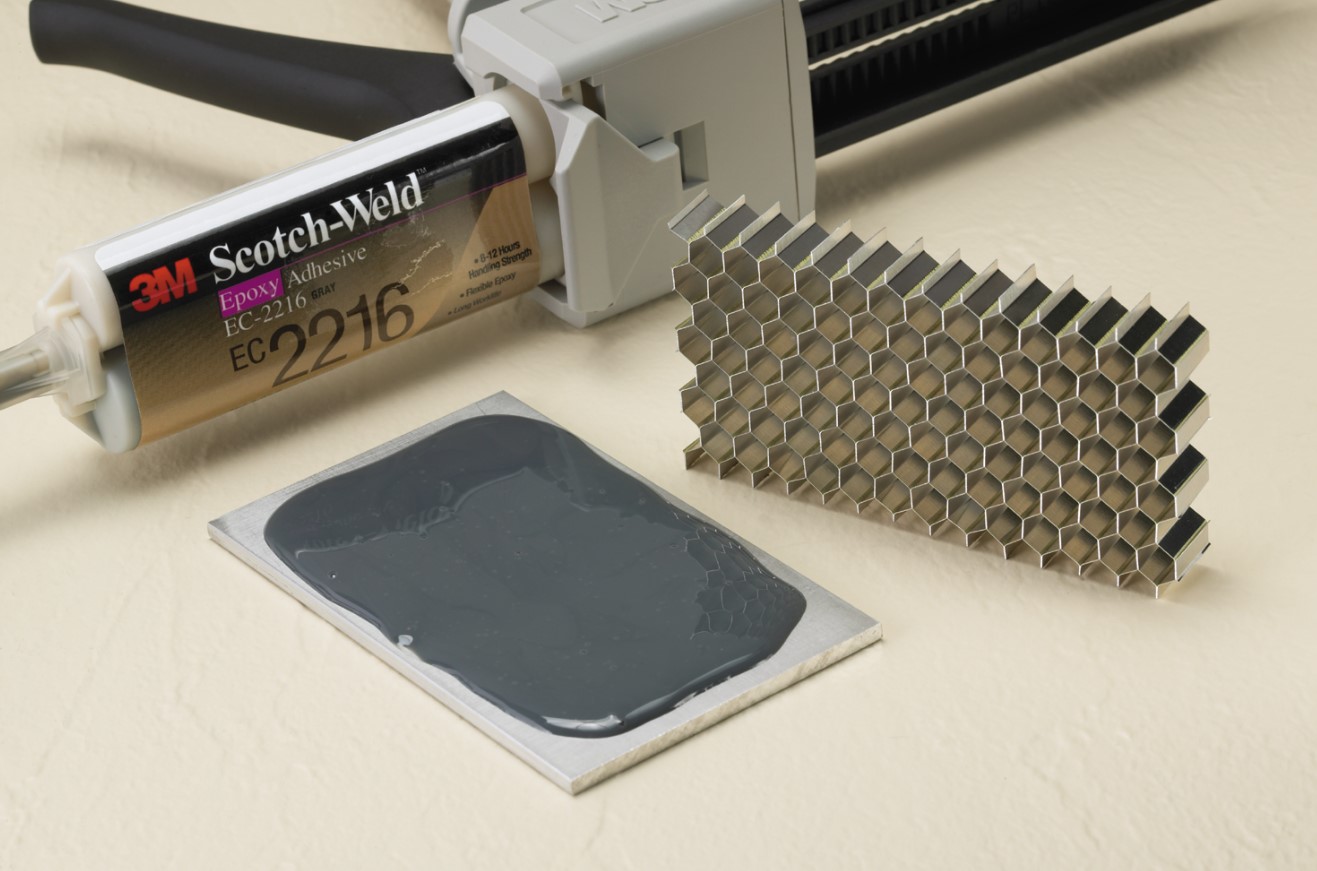
In a manufacturing or maintenance facility, the question is rarely whether to bond, but which proven, branded system to use. Procurement managers and development engineers therefore increasingly look for named, documented solutions for structural joints: a well-chosen 3M Scotch-Weld structural adhesive brings with it the R&D behind the brand and predictable quality. Since the 3M Scotch-Weld product family includes numerous types spanning epoxies, polyurethanes, and acrylics, it is worth knowing precisely which one is suited to which task. In this article, we explain what makes 3M the industry benchmark, and look in detail at four Scotch-Weld solutions that cover most industrial structural bonding requirements.
What is a structural adhesive, and why is 3M the industry benchmark?
A structural adhesive creates a load-bearing bond: it distributes stress not at a single point, but across the entire bonded surface, and in many cases can replace screws, rivets, or welds.
Adhesion, the bond between the adhesive and the workpiece surface, is not the load-bearing element here. A well-designed structural joint transfers load evenly, reduces local stress concentrations, and can unite material combinations that would be difficult or impossible to fix with screws or welding.
3M is one of the defining developers in adhesive and bonding technology, and Scotch-Weld offers not a single product but an entire, well-structured product family, spanning automotive to electronics manufacturing, from which the right solution for any given task can always be selected.
Why choose 3M Scotch-Weld structural adhesive?
3M Scotch-Weld is one of industry's first choices because it offers the full chemistry of structural bonding within a single, coordinated system: rigid and flexible epoxies, polyurethane, and acrylic. This means the task doesn't have to be adapted to the adhesive, the adhesive can be chosen to suit the task.
Rigid epoxy is strongest where maximum strength and minimal movement are the goal. Flexible epoxy and polyurethane cope with vibration, thermal expansion, and joints in motion; acrylic is designed for difficult-to-bond, low surface energy plastics.
Surface energy describes how readily an adhesive wets a material's surface: the lower the surface energy, the harder it is for anything to bond to it.
The other reason is practical. Many Scotch-Weld structural adhesives are supplied in a dual cartridge with a static mixing nozzle, which mixes the two components at the correct ratio, bubble-free, at the moment of application. This eliminates the uncertainty of hand-mixing: there is no under- or over-dosed hardener, no trapped air, and the work remains cleaner. No separate mixing vessel or tool is needed, application is consistently repeatable from one workpiece to the next, and only as much material needs to be mixed as is required at any given time — minimising waste. The exact working time and mix ratio are always given on the product data sheet.
The dual cartridge is the format for manual application: for small-batch assembly, prototyping, repair, and maintenance work. For higher volumes, the same products are also available in bulk packaging for use with dispensing equipment.
Which 3M Scotch-Weld structural adhesive should you choose? (by material and load)
For rigid joints requiring maximum strength and minimal movement, a high-strength epoxy is the natural choice. However, if the joint is subject to vibration, thermal expansion, or contraction, it is worth switching to a flexible epoxy or polyurethane, as these maintain the bond during movement, whereas a rigid adhesive is more likely to crack under such conditions. For mixed-material or moving joints, and for substrates such as concrete, wood, or rubber, polyurethane is the versatile solution; for difficult-to-bond, low surface energy plastics, a targeted acrylic adhesive is required.
The choice can be clarified with a few quick questions:
- What materials need to be joined, and what are their surfaces like?
- What magnitude and type of load will the joint experience?
- Is there movement or vibration in the joint?
- Will the joint experience thermal movement i.e., expansion or contraction?
- Does the substrate include any low surface energy plastics (PE, PP)?
The same logic applies when translated into specific industries: the automotive industry uses these systems for bonding mixed materials and panels, electronics manufacturing for precise, controlled assembly, and the metals industry for high-strength structural joints. If the primary question is the chemistry itself, the choice between epoxy, polyurethane, and acrylic, further detail is available in our overview article on adhesive types.
The main types of 3M Scotch-Weld structural adhesive (4 highlighted solutions)
Flanker stocks the full Scotch-Weld range, and the four types below cover the vast majority of industrial structural bonding requirements. Here is a detailed look at what each one is suited for: all are two-component, but each is best suited to a different task.
3M Scotch-Weld™ Epoxy Adhesive DP420 – the high-performance epoxy
3M Scotch-Weld™ Epoxy Adhesive DP420 is a two-component, epoxy-based structural adhesive, available in black, in a 400 ml cartridge. It is a high-performance, toughened, non-sag type, meaning it does not run on vertical surfaces, suitable for replacing mechanical fastenings such as screws and rivets. It is recommended wherever the strongest, most rigid bond is required and the finished assembly must hold its form under load. A typical example is replacing a rivet- or screw-fixed metal joint with adhesive bonding: the load is then no longer concentrated around a few holes but distributed across the entire bonded surface. Precise strength and processing values are given in the product's technical data sheet.
3M Scotch-Weld™ Epoxy Adhesive 2216 B/A – the flexible epoxy
3M Scotch-Weld™ Epoxy Adhesive 2216 B/A is a flexible, two-component epoxy adhesive, available in grey, in a 250 ml format, curing at room temperature. It provides a high-strength bond with both high shear and peel strength, resisting forces that would slide or pull the surfaces apart, whilst remaining exceptionally flexible, making it ideal wherever vibration, thermal expansion, and contraction occur regularly. A good example is a panel or enclosure bond subject to vibration and thermal movement: a rigid adhesive may crack over time, whereas the flexible epoxy follows the movement of the material. It also performs well at low temperatures without becoming excessively brittle, making it a viable option for moving joints exposed to thermal cycling.
3M Scotch-Weld™ Urethane Adhesive DP604NS – the versatile polyurethane
3M Scotch-Weld™ Urethane Adhesive DP604NS is a two-component polyurethane adhesive, available in black, in a 48.5 ml dual cartridge. Non-sag and fast-working, it nevertheless delivers a flexible bond and performs reliably on a wide range of substrates: concrete, ceramic, wood, plastic, rubber, and metal can all be bonded with it. It is a strong choice for mixed-material assemblies where, for instance, wood, metal, and plastic all appear in the same structure and a single flexible bond is required for each element, combining flexibility and broad material compatibility in one solution.
3M Scotch-Weld™ Low Odour Acrylic Adhesive DP8010 – the acrylic for difficult-to-bond plastics
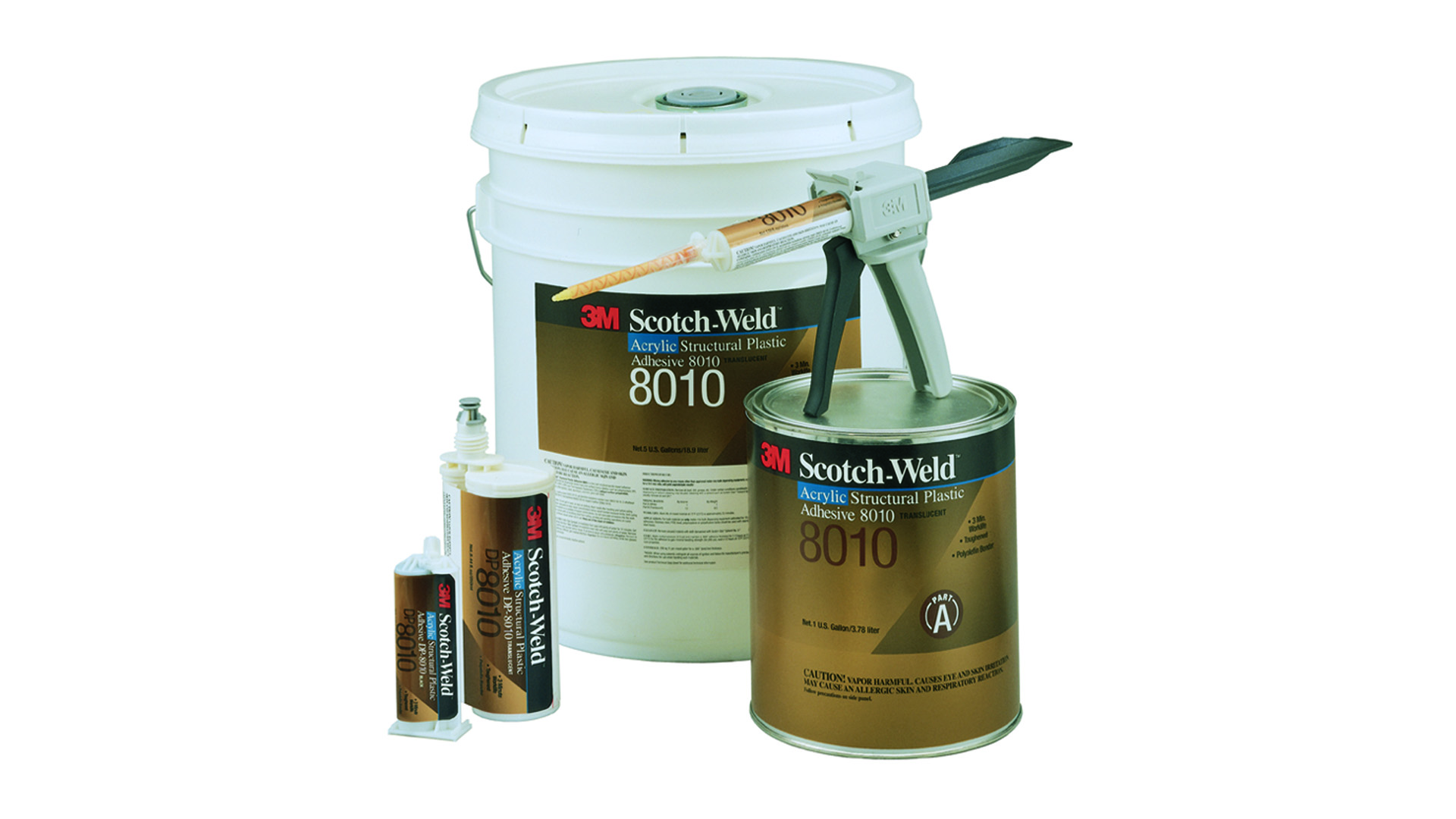
3M Scotch-Weld™ Low Odour Acrylic Adhesive DP8010 is a two-component, acrylic-based structural adhesive, available in blue, in a 45 ml dual cartridge. It was developed specifically for bonding low surface energy plastics, primarily polyethylene (PE) and polypropylene (PP), which are difficult or impossible to bond reliably with most conventional adhesives. These plastics often appear wherever a component has a smooth, somewhat waxy feel and adhesives struggle to take hold. Typical examples include polypropylene or polyethylene housings, enclosures, and components, where most other adhesives fail to form a lasting bond. The key advantage of DP8010 is precisely that it bonds many grades of PE, PP, and thermoplastic elastomers (TPE) without a primer or separate surface treatment, making it the solution wherever conventional adhesives fall short.
How to apply 3M Scotch-Weld structural adhesive correctly
A lasting bond has two prerequisites: correct mixing and careful surface preparation. For many Scotch-Weld types, mixing is handled automatically and accurately by the dual cartridge and static mixing nozzle; the mix ratio and working time are given on the data sheet for the specific product.
Surface preparation determines whether the bond will last. The surfaces to be bonded must be clean, dry, and free of grease, because even the best structural adhesive cannot form a lasting bond on a surface contaminated with dust, oil, or moisture. For low surface energy plastics (PE, PP), conventional adhesives typically also require a separate pre-treatment such as priming or surface activation. This is precisely why targeted acrylic types were developed: DP8010 bonds many grades of these plastics without a primer, but cleaning and degreasing remain essential even here.
Work in a well-ventilated area, wear protective gloves and eye protection, and follow the product's safety warnings. The precise timing of application, assembly, and load-bearing capacity, as well as heat resistance, vary by product type and should always be planned on the basis of the technical data sheet for the specific type being used.
Why Flanker? (Official 3M distributor in Hungary)
Flanker has been the official 3M distributor in Hungary for over 20 years, since 1998. This means you don't need to select the right type on your own from a catalogue: our specialists recommend a specific Scotch-Weld solution based on the task, the material pairing, and the load, and the products you need are typically available from stock.
Flanker provides comprehensive, end-to-end solutions to eight industries, including automotive, electronics manufacturing, and the metals sector. Behind our online catalogue stands a knowledgeable professional partner who knows which Scotch-Weld type is right for the job, and who is on hand to provide expert guidance when needed. A full overview of the 3M adhesives range is available in our article 3M Adhesive: A Solution for Every Situation.
The full range of 3M Scotch-Weld structural adhesives is available in the Structural Adhesives category on our website. If you are unsure which type is right for your application, please contact our specialists, who are happy to assist in selecting the right solution and pack size.
Frequently Asked Questions
What is a structural adhesive?
A structural adhesive creates a load-bearing bond that distributes stress across the entire bonded surface, not at a single point. It can therefore replace screwed, riveted, or welded joints in many applications and can also unite dissimilar material pairings.
Why is 3M Scotch-Weld an industry benchmark?
3M Scotch-Weld offers the full chemistry of structural bonding within a single, coordinated system: rigid and flexible epoxies, polyurethane, and acrylic. This means the right chemistry can always be matched to the task, and many types are available in precisely-dispensing dual cartridges.
Which 3M structural adhesive is suitable for replacing screws and rivets?
For replacing rigid, high-strength mechanical fastenings, 3M Scotch-Weld™ Epoxy Adhesive DP420 is the appropriate choice, available in black in a 400 ml cartridge. Precise strength values are given in the product's technical data sheet.
Which 3M adhesive withstands vibration and thermal expansion?
For joints subject to vibration, thermal expansion, and contraction, 3M Scotch-Weld™ Epoxy Adhesive 2216 B/A flexible epoxy is the right choice, it remains highly flexible whilst delivering high shear and peel strength, and also performs well at low temperatures.
Can PE and PP plastics be bonded with a structural adhesive?
Low surface energy plastics such as polyethylene (PE) and polypropylene (PP) are difficult to bond with most adhesives, which typically also require a primer or surface activation. 3M Scotch-Weld™ Low Odour Acrylic Adhesive DP8010 was developed specifically for this task and bonds many grades of these plastics without separate pre-treatment. Cleaning, drying, and degreasing of the surface remain necessary, however.
What surfaces is 3M Scotch-Weld™ Urethane Adhesive DP604NS suited to?
3M Scotch-Weld™ Urethane Adhesive DP604NS is a two-component polyurethane adhesive that is non-sag and fast-working, yet flexible, and is suitable for a wide range of surfaces: concrete, ceramic, wood, plastic, rubber, and metal. It is available in black in a 48.5 ml dual cartridge.
How do I find out the mix ratio and cure time?
The precise mix ratio, working time, cure time, and heat resistance are always given in the technical data sheet for the specific product, as these vary by type. Flanker's specialists are also happy to help interpret the data.
Where can I obtain 3M structural adhesive in Hungary?
The full range of 3M Scotch-Weld structural adhesives is available from Flanker, which has been the official 3M distributor in Hungary for over 20 years. The types you need are typically available from stock; expert advice is provided where required.


